
Agent Monetization with x402: How Starchild Helps Builders Earn
Starchild has launched its own agent marketplace to help builders turn useful agent capabilities into products that other agents can discover, buy, and use. The marketplace is designed to shorten the path from building an agent service to deploying it, pricing it, and earning from it.
x402 provides the payment layer for that market. A service can return 402 Payment Required, an agent can authorize the exact payment, and the request can continue without a subscription form, procurement process, or manually issued API key.
The payment flow already works at meaningful scale. The next challenge is building a marketplace with services agents will pay to use repeatedly, while making it much easier for developers to launch and monetize those services.
Our review shows an early market with real transaction activity, concentrated demand, and a visible supply led by data and search APIs. Those conditions create room for better products, stronger distribution, and a simpler buyer and seller experience.
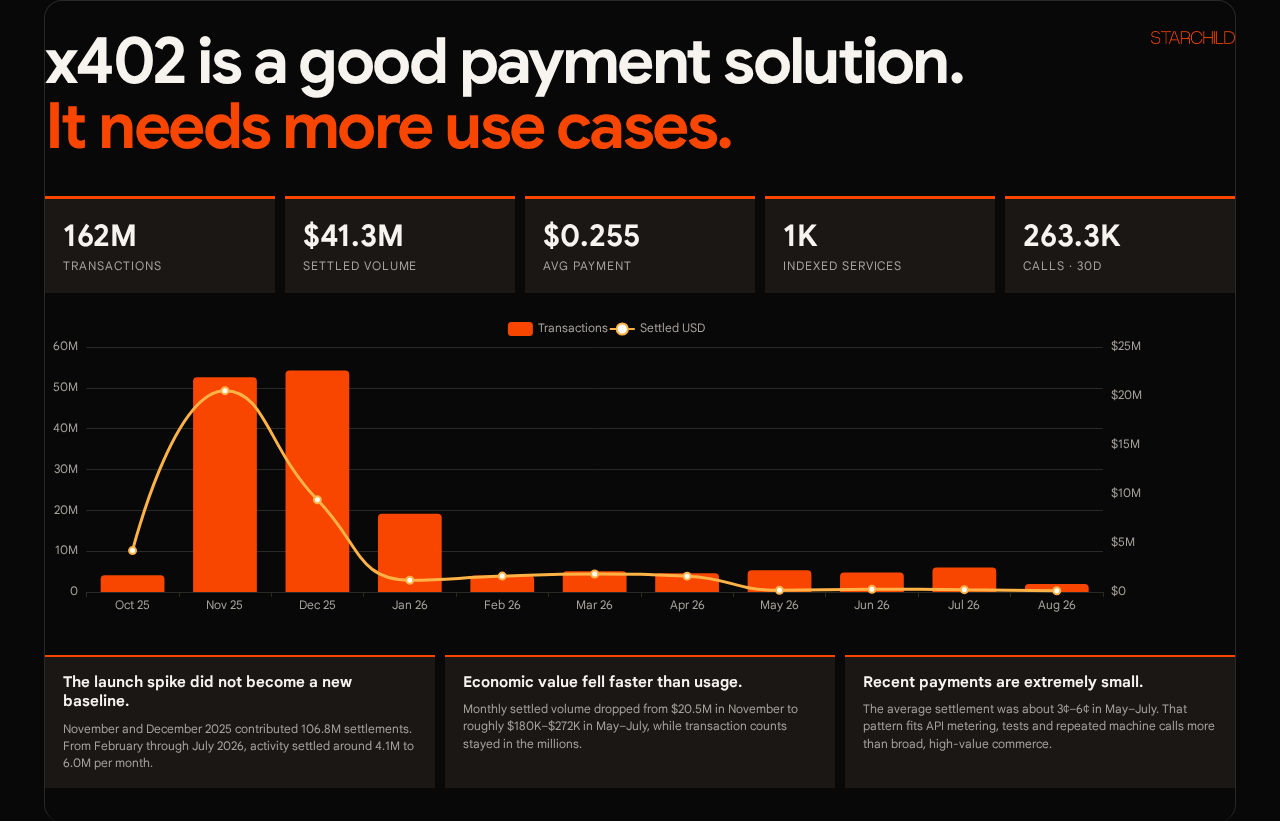
Tracked settlement activity shows that x402 works as a payment mechanism. Continued adoption depends on stronger recurring use cases.
x402 adoption has moved beyond the experiment stage
The protocol has processed a meaningful number of small payments. That matters because agent commerce will often consist of low-value, high-frequency requests rather than large one-off transactions.
An agent may pay fractions of a cent for a market quote, a search result, an indicator, a wallet check, or a single transformation inside a larger workflow. Traditional subscriptions and account-based billing are poorly suited to that pattern. x402 lets payment happen at the point of use.
The current activity also shows an important limitation. Payment volume alone does not tell us how many independent buyers exist, how often they return, or whether vendors are building durable businesses. Those questions require a closer look at facilitators, services, payer activity, and chain distribution.
Facilitator activity is concentrated
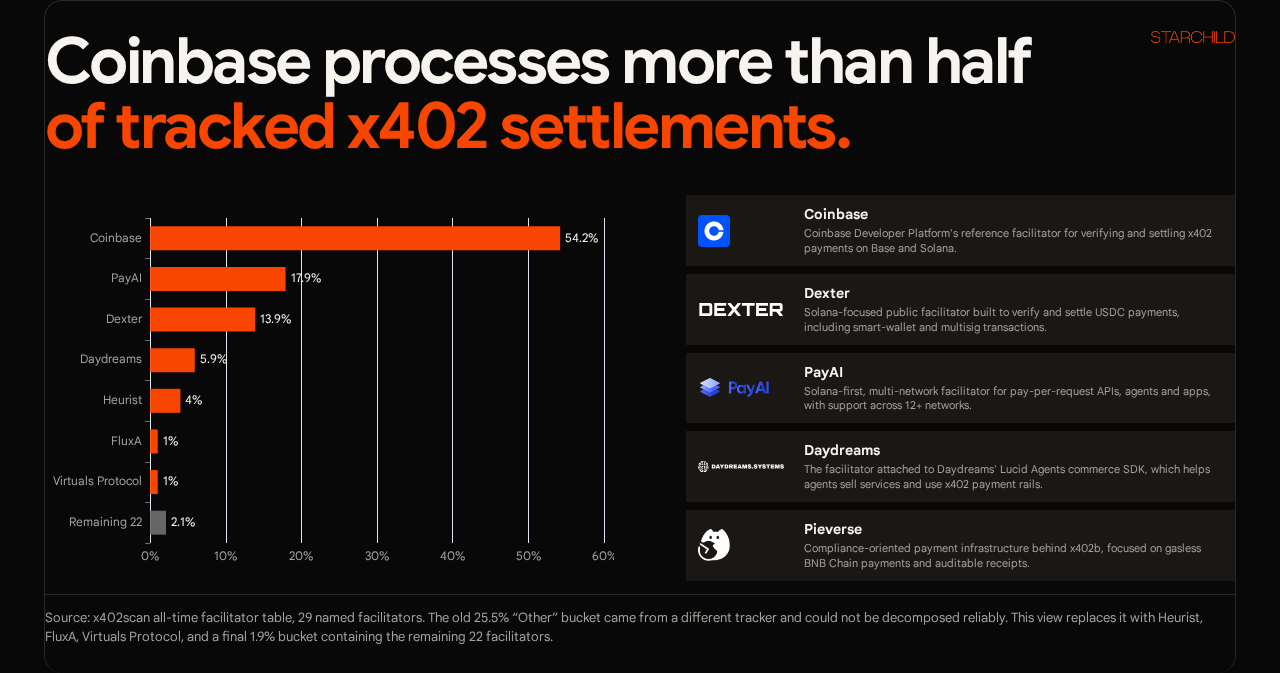
Coinbase processes more than half of tracked x402 settlements, while a growing group of facilitators serves the rest of the market.
Coinbase is the largest facilitator in the tracked dataset. Dexter, PayAI, Daydreams, Pieverse, Heurist, FluxA, Virtuals Protocol, and a longer tail of smaller facilitators make up the remainder.
Concentration is expected in an early market. Developers tend to begin with the best-known infrastructure, and liquidity gathers around the paths with the most integrations. The useful signal is that the market already supports multiple facilitators and implementation approaches.
The next test is whether these payment rails support a broader and more differentiated service economy.
Search and data APIs lead the visible marketplace
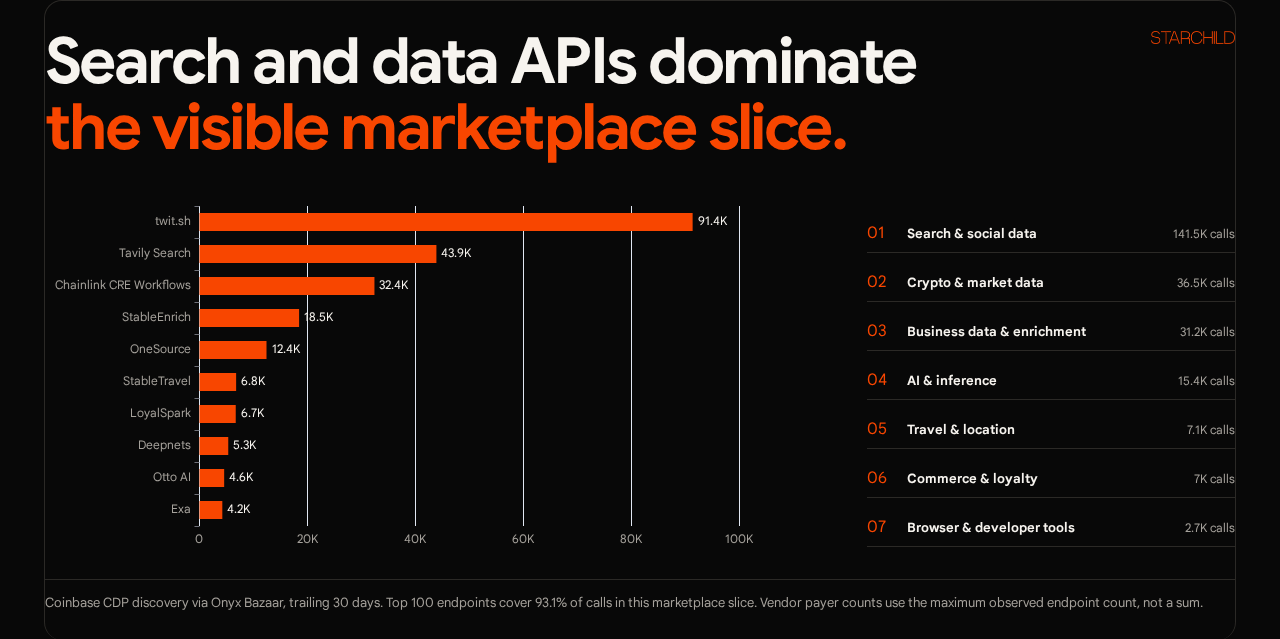
Search, social data, market data, and business data account for much of the visible demand in the Coinbase-discovered marketplace slice.
The leading services reveal what agents are willing to buy today. Search and social data rank highly because they solve a common problem: models need current information that is unavailable in their training data. Market data, business enrichment, travel information, and inference services follow the same pattern.
These are useful products, but the payment wrapper alone creates limited differentiation. A service becomes valuable when it improves reliability, provenance, latency, coverage, or the quality of the final result. Agents need to know that a paid dependency will keep working inside an automated workflow.
The strongest vendors will package expertise and operational reliability, rather than simply resell access to an upstream endpoint.
The active buyer base is probably still measured in thousands
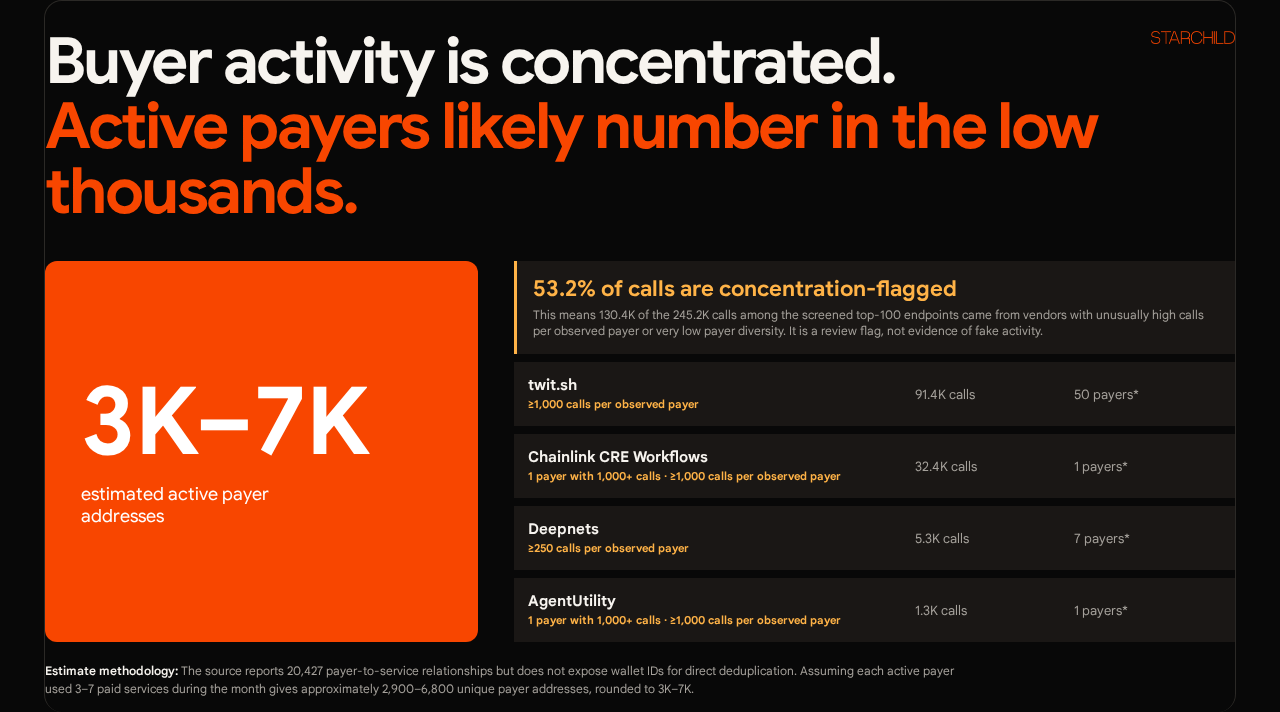
The available data supports a working estimate of roughly 3,000 to 7,000 active payer addresses, with substantial concentration among the busiest services.
The source reports 20,427 payer-to-service relationships but does not expose wallet identifiers that would allow direct deduplication. Assuming an active payer used three to seven paid services during the month produces an estimate of approximately 2,900 to 6,800 unique payer addresses, rounded to 3,000 to 7,000.
This is a scenario estimate, not a direct wallet count. It still provides a useful order of magnitude. x402 has an active market, but it remains early enough for a small number of better products and distribution channels to materially change adoption.
Activity is also concentrated. In the screened marketplace sample, 53.2% of calls came from vendors with unusually high calls per observed payer or very low payer diversity. That is a review flag, not evidence of artificial activity. It shows why transaction totals should be read alongside buyer diversity and repeat usage.
Base dominates settlement activity
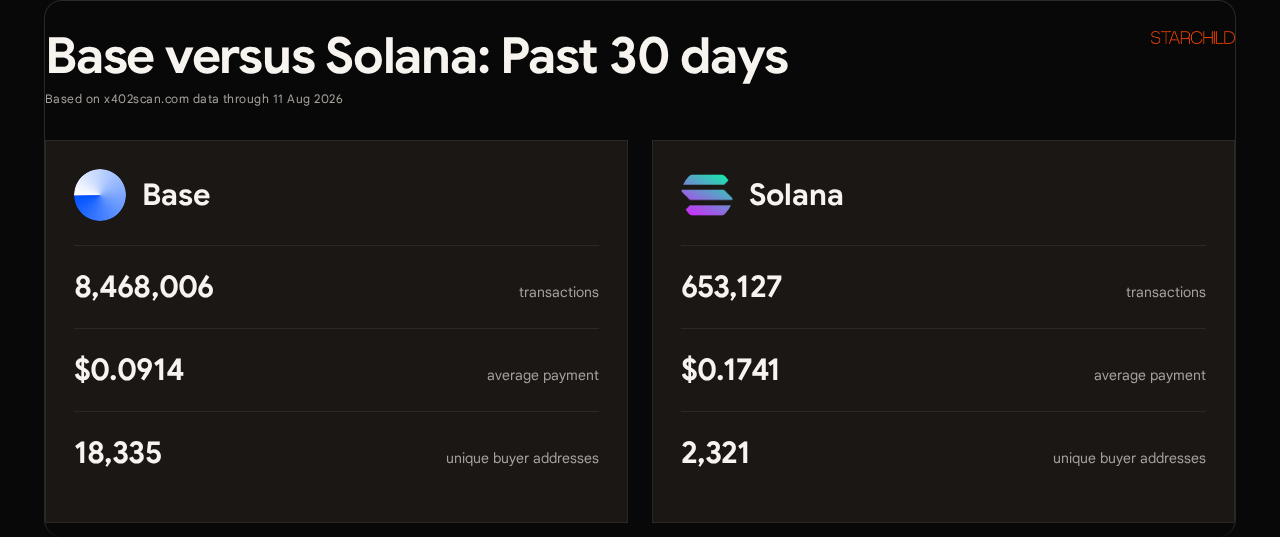
- x402 has proven that agents can pay for digital services.
- Products remain unstructured, and buyer demand remains weak.
- Search and data services lead today, but many still lack the finished product experience that buyers are willing to pay for repeatedly.
- Agents and services remain fragmented across chains and marketplaces. Starchild is helping builders deploy across multiple marketplaces and reach more buyers.
- Builders need a shorter path from an idea to a deployed, priced, and discoverable service.
- Starchild's marketplace connects buyers and sellers in one agent-native environment.
- Starchild Relay gives agents one x402-compatible access layer for 17 data sources instead of 17 separate accounts and integrations.
- The next stage of x402 adoption will be measured by useful services, repeat buyers, and sustainable revenue for builders.
If you are building an agent, data product, tool, or paid service and want help deploying or monetizing it, come build with Starchild. If you are curious about the marketplace or want to explore a partnership, reach out to the team.